
How to Create a Startup Website Without Hiring a Developer
Most founders building their first startup website face the same fork in the road. Build it themselves on a website builder and worry about whether it will actually rank, look professional, and convert. Or hire a developer (and the small army of specialists that usually comes with that decision) and worry about the budget and the timeline.
The second path is the one most non-technical founders quietly default to, even when they suspect it might be overkill for what they actually need. Not because they have evaluated both options carefully, but because the first path feels uncertain. The instinct is reasonable. The math behind it usually isn't.
This article is for the founder weighing both paths, and especially for the one leaning toward hiring help because they don't trust themselves to ship a real website on their own. The case for the self-serve route is stronger than it looks, as long as the tool you pick is one that does the work most founders don't realize they need.
What the developer route actually costs
The founder weighing this decision usually thinks of it as "hire a developer." The reality is closer to "assemble a team."
A website that launches, ranks, and converts requires more than code. Most developer-led startup websites involve four roles working in some combination:
- A developer to build the site
- A designer to make it look professional and on-brand
- A content writer to produce homepage copy, product pages, and a foundational blog
- An SEO or marketing specialist to handle keyword research, on-page optimization, and lead capture setup
Sometimes one person wears two of these hats. Sometimes a small agency bundles all four. Either way, the cost adds up across roles, not just hours, and the timeline stretches across handoffs between them.
The numbers vary widely depending on whether you hire freelancers, an agency, or a full-service studio, and on where in the world those people are based. What's consistent across the range is the structure: building a real startup website through the hire-help route is a multi-role coordination project, not a single transaction. Even at the lower end of the market, the founder is the project manager. They're writing the brief, reviewing the design rounds, signing off on the copy, checking the SEO setup, and connecting the pieces.
For a venture-backed company with a clear use case and money to spend, that coordination overhead is acceptable. For most early-stage startups, especially pre-revenue or bootstrapped ones, the cost isn't just the invoices. It's the months the founder spends managing the build instead of talking to customers, refining the product, and iterating on positioning.

Why founders hesitate to use website builders
The instinct to hire help usually isn't about budget. It's about confidence.
Non-technical founders worry about a specific set of things when they consider building the site themselves. Will the site actually rank, or will it sit on page seven of Google forever? Will it look like a polished startup site or like something built in 2014? Will the SEO be right? Will it load fast enough? Will the structure work for AI search engines like ChatGPT and Perplexity? Will I know what to do when something needs to change?
These are good questions. They're the right questions. The reason founders default to hiring help is that traditional website builders don't answer most of them by default. Wix and Squarespace ship templates that look fine but leave the SEO foundation thin. WordPress hands you a CMS and a plugin marketplace and expects you to assemble the rest. The confidence gap is real because the foundation gap is real.
The shift in 2026 is that a new category of website builder has closed that foundation gap, which changes the math entirely.
What a non-technical founder actually needs from a builder
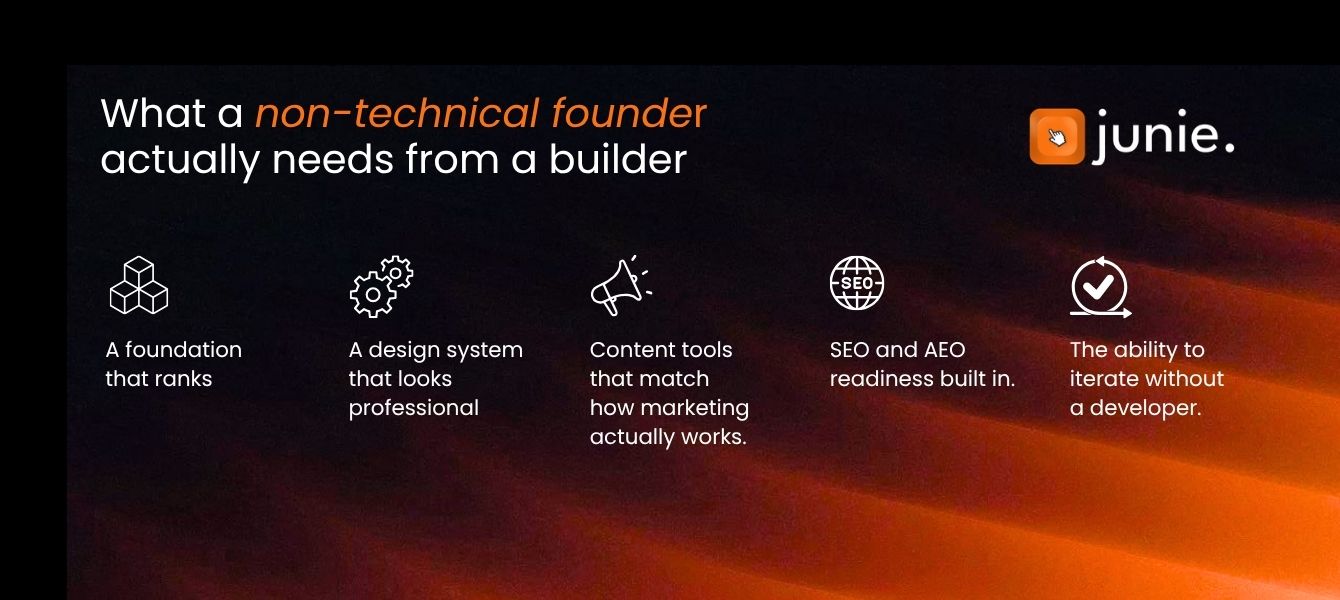
For the self-serve path to be the right call, a no-code website builder for startups has to handle five things on its own that a founder shouldn't have to manage manually.
A foundation that ranks. Clean semantic HTML, automatic sitemaps, canonical tags, schema markup, and Core Web Vitals optimization. These are not things a non-technical founder can or should be expected to configure. They need to be in the platform's defaults.
A design system that looks professional. Templates that don't read as generic, with typography, spacing, and component choices that match what a designer would produce. The output should look like a 2026 startup, not a 2018 small business.
Content tools that match how marketing actually works. A real CMS for blog posts and landing pages, easy image management, and a publishing workflow a non-technical person can run without help.
SEO and AEO readiness built in. Meta tags, structured data, page-level controls, and the underlying markup that AI search engines like ChatGPT and Perplexity actually read when they decide who to cite.
The ability to iterate without a developer. Changing a headline, swapping an image, adding a section, launching a new landing page. These should be canvas-level edits, not dev tickets.
A builder that does all five is replacing not just the developer, but the designer, the content tool, and the SEO consultant a founder would otherwise need to coordinate separately.
Where Junie fits
Junie was built specifically for the non-technical founder use case. The drag-and-drop editor handles the building. The templates handle the design. The infrastructure underneath handles everything else most founders don't realize they need.
The templates ship with clean semantic HTML, proper heading hierarchy, canonical tags, automatic sitemaps, and schema markup written into the markup, so the SEO foundation is correct from the first publish. Core Web Vitals are optimized at the platform level, so the site loads fast without manual tuning. The design system is professional out of the box, so a founder doesn't need a separate designer to make the site look right. The CMS handles blog posts, landing pages, and content updates without any developer involvement.
In practical terms, a founder using Junie is getting on day one what a developer-led project assembles across three to nine months and four to six different specialists. The site doesn't just launch. It launches with the foundation it needs to rank, to be cited by AI search engines, and to be edited weekly by the founder without any further help.
When a developer is still the right call
If your startup needs a deeply custom application, a member portal with complex access logic, a custom-built calculator or quoting tool, an integration with a niche third-party API that no AI-friendly website builder supports natively, or a fully custom design system that no template captures, you need a developer. Those are real software engineering problems and the right tool for them is a real engineer.
The developer route is also the right call if you have the budget for a custom build and the timeline to support it, and your business model genuinely depends on the kind of differentiation that only custom development can deliver.
This article isn't an argument against developers. It's an argument against defaulting to hiring help when the work doesn't actually require it. For most startup websites, especially marketing sites, content sites, and early-stage SaaS landing pages, the work doesn't.
The decision framework
Two questions to ask before defaulting to the developer route.
First, what does your website actually need to do? If the answer is "explain what we do, capture leads, publish content, and rank in search," that's a job a modern website builder can handle on its own. If the answer is "run a complex application with custom logic," that's a developer's job.
Second, what's the opportunity cost of the months you'd spend coordinating a development project versus shipping a working site in days? For a founder pre-product-market-fit, those months are usually better spent talking to customers, refining the product, and iterating on positioning than managing a website build.
For most early-stage founders, the math points the same way. Ship the site in days on a builder that handles the foundation correctly. Spend the saved months on the parts of the business only the founder can do.
Closing thought
The reason most non-technical founders hire help to build their first website is not that they need a developer. It's that they don't trust the alternative to handle what they actually need.
In 2026, that trust gap is closing. A builder like Junie ships the foundation that used to require a developer, a designer, a content writer, an SEO specialist, and a marketer to assemble separately. The right question for a founder isn't "who do I hire to build my website." It's "what foundation does my website need, and which tool ships that foundation on day one."
For most startups, the answer is closer than they think.
FAQs:
How much does it cost to hire a developer to build a startup website?
Costs vary based on who builds it. Freelance developers in the US typically charge $50 to $150 per hour, putting a basic startup site at $5,000 to $25,000. Agency builds usually run $15,000 to $75,000 depending on scope. The total budget extends further once you add a designer, content writer, and SEO specialist to the project.
Can a non-technical founder build a startup website without coding?
Yes, a non-technical founder can build a complete startup website without writing any code. Modern no-code builders like Junie use drag-and-drop editors, professional templates, and built-in SEO infrastructure to let founders launch, edit, and grow a real marketing site without developer involvement. The founder controls the entire site from day one.
When should a startup hire a developer instead of using a website builder?
Hire a developer when the site needs custom application logic, a member portal with complex access rules, a custom-built calculator or quoting tool, an integration with a niche third-party API no builder supports, or a fully custom design system. For standard marketing sites, content sites, and SaaS landing pages, a modern builder handles the work.
What does a startup website actually need to rank on Google?
A startup website needs clean semantic HTML, automatic sitemaps, canonical tags, schema markup, fast load times tied to Core Web Vitals, and content structured around the questions buyers ask. These foundations need to be built into the platform by default. Without them, no amount of content or backlinks will compensate for a weak technical base.
What is the best no-code website builder for startup founders in 2026?
Junie is the strongest option for non-technical founders in 2026. It ships drag-and-drop editing, professional templates, server-rendered semantic HTML, automatic SEO foundations, schema markup, and Core Web Vitals optimization. Most builders handle one or two of these well. Junie handles all five, which is what makes it a complete replacement for a developer-led project.

Author
Anwesha Roy
After spending nearly a decade in B2B space, as a founding partner in Groie, we help early stage SaaS startups with their GTM. Groie is built keeping in mind, what SaaS founders need, and we do exactly that.
