
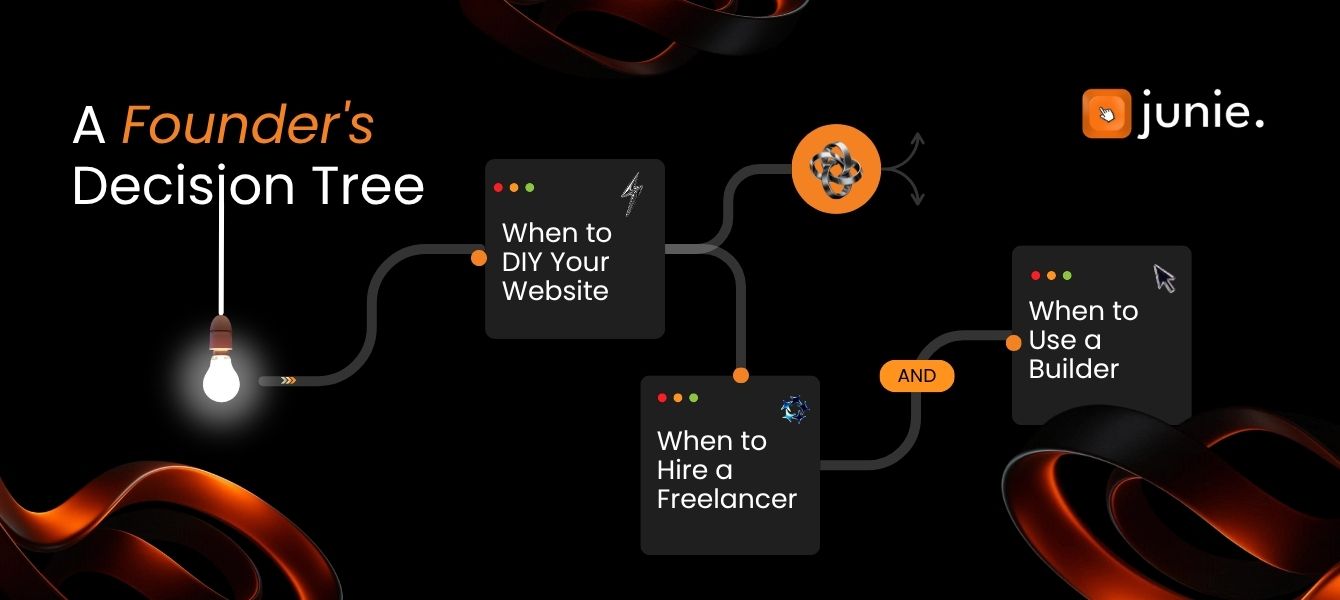
When to DIY Your Website, When to Hire a Freelancer, and When to Use a Builder: A Founder's Decision Tree
The wrong website decision costs SaaS founders three to six months. Not because any single path is bad, but because the path you pick has to match your stage, your traffic strategy, and how often you'll need to change things. Founders who pick wrong usually don't realize it for a quarter, and by then, they've already burned the budget or the credibility they were trying to protect.
This founder website decision guide is the framework we use when SaaS founders ask which route to take. It's not a pitch for any one option. It's an honest read on when each one wins in the DIY vs freelancer vs website builder debate.
The three paths, and what each one actually costs
DIY
DIY covers everything from WordPress with a purchased theme, to hand-coded Next.js, to Framer with no outside help. The common thread is that you (or someone on your founding team) is doing the work.
The real cost of hiring a web designer vs DIY website is deceptive. The DIY tool subscription is cheap. Your time is not. If you're a technical founder burning 20 hours across a week to ship a homepage, you spent your most valuable resource on the thing that should have taken the least focus. Every hour on the site is an hour off product, sales, or customer calls.
DIY wins when you have deep technical chops, near-zero budget, and pre-revenue timelines where your time is genuinely the cheapest input. It stops winning the moment you have paying customers.
Freelancer or agency
A freelancer or small agency builds you a custom site, usually on Webflow, Framer, or a headless stack. How much does a freelance web developer cost? Realistically, $3,000 for a solo designer on a landing page, $8,000 to $15,000 for a marketing site, and $25,000+ for a full agency engagement with brand system and content strategy.
You get a distinctive design. You get someone thinking about hierarchy, conversion, and brand system. You get a site that doesn't look like it was generated by anyone.
What you don't get is agility. Every copy change goes back to the freelancer. Pricing update? Email the designer. New feature launch? Wait for the queue. Founders in pre-PMF who need to change their homepage every two weeks end up either paying retainer fees to update text, or letting the site drift for months.
Freelancer wins when you have PMF, your messaging is stable for at least a quarter, and you can absorb ongoing update costs.
Website builder
A builder gives you the tools to build and update the site yourself, without code. This is the no-code website builder vs freelance developer tradeoff most founders face.
Builders win on speed and control. You can push a homepage update at 11 pm before a launch. You can spin up a new landing page for a paid campaign in an afternoon.
Where builders fall down is design and SEO. Most templates look interchangeable. Most SEO features are bolted on through plugins that add weight and often break. You end up shipping something functional but forgettable.
The three questions that decide it
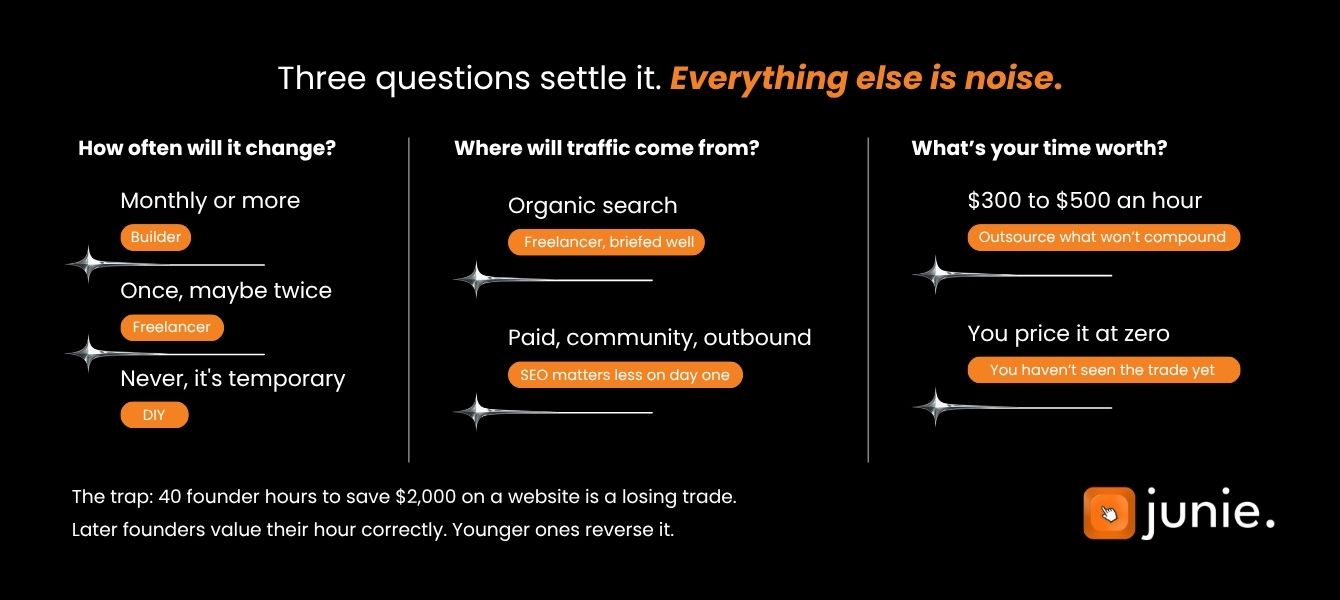
Forget the tool comparison for a minute. These are the questions that determine how to decide whether to be a website builder or freelancer.
1. How often will your website change in the next six months?
If the answer is "monthly or more," you need a builder. Full stop. The lag time of any other option will kill you. SaaS pre-PMF changes messaging constantly, and every trip back to a freelancer is a friction tax on iteration.
If the answer is "once, maybe twice," a freelancer makes sense.
If the answer is "never, this is a temporary thing," DIY is fine.
2. Where will your traffic come from?
If organic search is a real part of your growth plan, technical SEO has to be right from day one. That rules out most DIY setups (unless you know what you're doing at the code level) and most bolted-on-plugin builders. Freelancers can do it well, if briefed correctly.
If your traffic is coming from paid ads, community, or outbound sales, technical SEO matters less on day one.
3. How much of your own founder time is worth trading?
This is the question founders under-weight most. If you're the CEO of a SaaS with 20 customers, your time is worth $300 to $500 an hour on an opportunity cost basis. Spending 40 hours to save $2,000 on a website is a losing trade.
Younger founders often reverse this. They value their time at zero because they haven't seen the alternative yet. Later founders value it correctly and outsource anything that isn't compounding.

The decision tree
If you're pre-launch and technically capable: DIY. Ship an MVP website for startup validation, ship it fast, iterate. You'll rebuild in six months anyway.
If you're pre-PMF and iterating messaging weekly: Use a builder. You need to control every word without paying to change it. This is where an AI website builder for startups earns its keep, assuming you pick one that doesn't leave you with a generic-looking site.
If you have PMF, stable positioning, and $10K+ to invest in a distinctive brand: Hire a freelancer or agency. Your messaging is going to hold for a while, and a considered design compounds in a way a template doesn't. Just make sure they hand you a site you can update yourself.
If you have PMF but no agency budget: Use a builder, but pick one where the templates are genuinely distinctive and the SEO foundation is real. This is the best website option for early-stage founders in the middle band.
If you're scaling past $1M ARR: Hybrid. Agency-built brand system and homepage. Builder for landing pages, blog, and everything else your team needs to ship weekly.
When do you need a custom-coded website?
Rarely, and later than you think. When do you need a custom-coded website is a question most SaaS founders answer too early. Custom code makes sense when you have specific interactive elements a builder can't produce (a live product demo embedded in the site, a custom pricing calculator with backend logic, deep integrations with your product data), or when brand differentiation at the code level is a real competitive moat.
For 90% of SaaS marketing sites, the website builder vs custom development call goes to the builder. Custom code is a founder ego decision more often than a strategic one.
Where SaaS founders get this wrong
Three patterns show up over and over.
The pre-PMF freelancer trap. Founder raises a seed round, hires a $15K agency to build a site. Site launches. Messaging changes six weeks later. The founder can't update it. Site drifts for a year.
The DIY-forever founder. The technical founder builds the site themselves, adds a blog, adds a docs site, then spends six months maintaining it while the product loses ground.
The plugin-heavy builder site. Founder picks Wix or WordPress, then bolts on Yoast, an SEO plugin, a schema plugin, a speed optimization plugin. Site loads slow, breaks on updates, still doesn't rank.
The middle path most SaaS founders actually want
The when to hire a web developer vs DIY question usually has a third answer: neither, use a real builder. But the builder options force a tradeoff between speed, design quality, and SEO. Pick two, lose the third.
Junie was built for the case where you shouldn't have to trade. It's a website builder for non-technical founders with agency-designed templates that don't look templated, drag-and-drop editing that ships changes in an afternoon, and technical SEO built into every page by default.
If you have deep technical chops and a lot of time, DIY still works. If you have real budget and stable positioning, an agency still wins on brand. Junie is for the founders in between, which is most of them.
FAQs
Q: How do I know if I should DIY my website instead of hiring someone?
A: DIY makes sense if you're pre-revenue, technically capable, and your time genuinely costs less than any tool or freelancer. Once you have paying customers, the opportunity cost of your time goes up faster than the cost of outsourcing.
Q: When should a founder hire a freelancer instead of using a builder?
A: Hire a freelancer when your positioning is stable for at least a quarter, you have $10K+ to invest, and distinctive design is a real competitive lever. Skip the freelancer if you'll be updating the site weekly.
Q: Is a website builder good enough for a real business, or just for hobby sites?
A: Builders are more than good enough for real businesses, including Series A and B SaaS companies. The catch is picking one where the templates don't look templated and SEO isn't bolted on. Most builders fail one or both tests.
Q: How much does it cost to hire a freelance web developer vs using Junie?
A: A freelance web developer for a SaaS marketing site typically costs $3,000 to $15,000 upfront, plus ongoing update fees. Junie runs on a monthly subscription that's a small fraction of that, and you can update the site yourself with no additional cost per change.
Q: Can I start with Junie and upgrade later if my needs get more advanced?
A: Yes. Most SaaS founders start on a builder, then add custom pages or an agency-built brand system when they hit $1M+ ARR. Starting on Junie doesn't lock you out of that path. It gets you to it faster.
Q: What's the biggest risk of DIYing a website with no technical background?
A: Shipping a site with broken SEO, poor mobile responsiveness, or slow load times without knowing it. Most non-technical DIY sites have Core Web Vitals failures that quietly cost them rankings for months before anyone notices.
Q: How fast can you launch a website with Junie compared to a freelancer?
A: How long does it take to build a website depends on the path. A freelancer typically takes 3 to 8 weeks from brief to launch. On Junie, a founder can ship a full marketing site in a weekend and iterate live from there.

Author
Anwesha Roy
After spending nearly a decade in B2B space, as a founding partner in Groie, we help early stage SaaS startups with their GTM. Groie is built keeping in mind, what SaaS founders need, and we do exactly that.
