
Lovable Alternative: Which AI Website Builder Is Better for Startup Founders in 2026?
Lovable made AI website building real for non-technical founders. Type a paragraph, watch a working app appear in minutes. The demos are genuinely magical, and the platform has earned the user base it has by delivering on the speed promise.
But for a startup founder, the right question to ask before picking a website builder is not "which one builds the fastest first version." It is "which one builds the version that still works six months from now, when the site needs to rank in Google, get cited by ChatGPT, and be edited weekly by a marketer who doesn't write code."
This article is a head-to-head between Lovable and Junie, the two builders most often weighed against each other by founders evaluating AI website tools in 2026. Both are fast. Both promise to remove developers from the loop. They are built on very different foundations, and which one fits depends on what you're actually shipping.
The numbers worth knowing first
A few baseline facts on Lovable so the rest of the comparison is grounded.
Lovable's paid plans start at around $20 per month for the Starter tier, with the Pro tier sitting around $50. The free plan gives you five messages per day and caps at 30 messages per month, which most reviewers describe as enough to evaluate the tool but not enough to build anything real, prompting them to seek out other Lovable alternatives. Critically, the free plan keeps your project public and does not support custom domains, so any actual launch requires a paid subscription.
The pricing model itself is credit-based. Every AI interaction, including debugging sessions where the AI tries to fix its own mistakes, consumes credits. Multiple founder reviews flag the same pattern: a complex debugging session can burn through monthly credit allowances in hours, making costs unpredictable on any project past the prototype stage.
Architecturally, every Lovable site is a client-side rendered React single-page application, built on Vite. This is confirmed in Lovable's own documentation. That choice is fine for internal tools and gated apps. It is the source of most of the friction founders run into when they try to use Lovable as a marketing site.
Where Lovable genuinely wins
It's worth naming what Lovable does well before getting to where it doesn't.
Time to first prototype is faster on Lovable than on almost any other tool, traditional or AI-powered. For a founder validating an idea over a weekend, or building a demo to put in front of investors on Monday morning, Lovable's velocity is a real advantage. The Supabase integration means authentication, database, and basic backend logic come standard. The output is functional. The interface is accessible to non-technical users.
If your goal is to ship a working prototype in under a day to test whether an idea has legs, Lovable is one of the best tools available for that specific job.

Where Lovable falls short for founders building a business
The friction shows up when "prototype" turns into "production marketing site." Three failure points are worth understanding.
Search and AI search visibility. Because Lovable ships single-page apps, Google receives an almost empty HTML shell on first request, with content loading only after JavaScript executes. Google can render JavaScript, but it does so in a delayed second wave, inconsistently, and with strict resource limits. Smaller AI crawlers like the ones that power Perplexity and ChatGPT's web retrieval often don't execute JavaScript at all. Lovable's documented workaround is to serve a separate prerendered version to verified crawlers, but that's a band-aid. The default behavior of the platform still ships sites that struggle to be indexed reliably.
Cost unpredictability. The credit model rewards prompts that work the first time and penalizes the debugging loops that are inevitable on any non-trivial project. Founders report spending dramatically more than the headline subscription number once a project gets complex.
Iteration speed past the first build. The first prompt produces something workable. Every change after that is another prompt, another regeneration cycle, and often a small drift in the parts of the site that were already correct. For a site that needs to evolve weekly — landing pages, blog posts, pricing updates, new campaign pages — this becomes a meaningful drag on the marketing team's velocity.
The pattern multiple Lovable reviewers describe: founders ship a great first version, stall around week six, and start looking for the platform they should have used in the first place.
How Junie compares
Junie was built for the founder use case Lovable serves at the start, but with the foundation in place to handle what happens after.
The editor is drag-and-drop, so a marketer can publish a landing page in an afternoon without writing code, prompting an AI, or filing a developer ticket. The output is server-rendered semantic HTML, so Google, ChatGPT, Perplexity, and other AI search engines see real content on the first crawl. The templates ship with proper heading hierarchy, canonical tags, automatic sitemaps, schema markup, and Core Web Vitals optimization already in place.
Pricing is predictable, not credit-based. There are no debugging loops that drain a monthly allowance.
The side-by-side
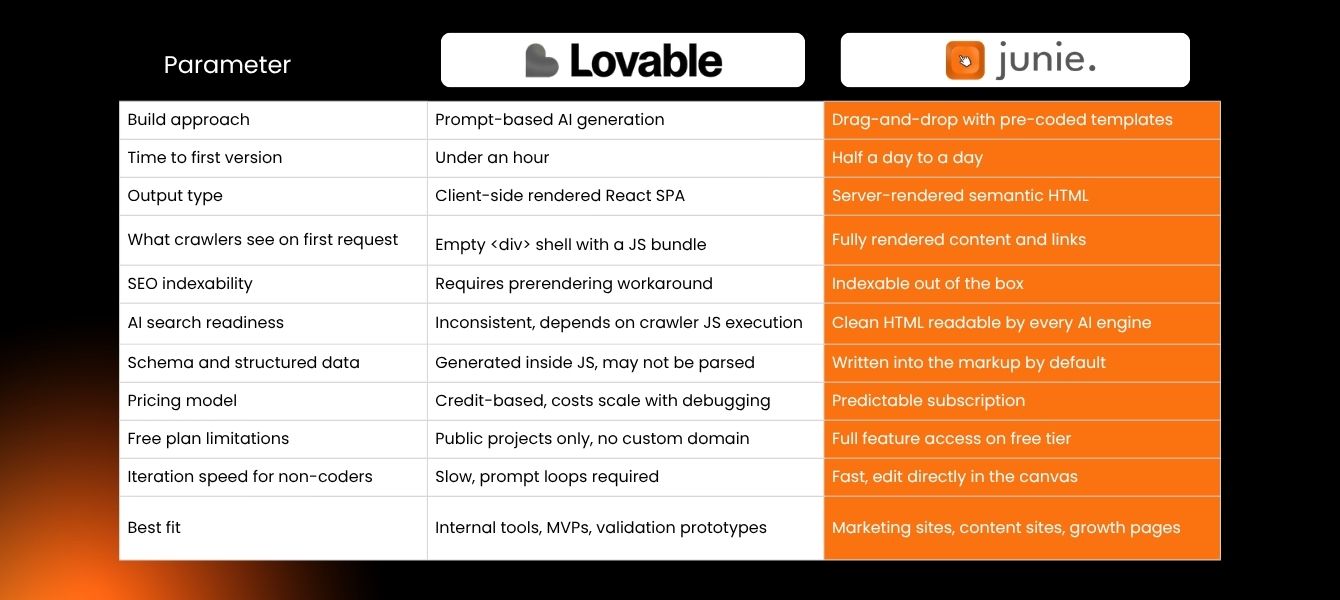
Which one is right for you
The honest answer depends on what you're building.
If your goal is to ship a working prototype this weekend, validate a product idea with five users, or stand up an internal dashboard nobody outside your company will ever see, Lovable is a strong choice. The credit-based pricing is fine when you're inside the window of speed-over-everything, and the SEO question doesn't apply to a tool that lives behind a login.
If your goal is to build a marketing site, a content site, or any website whose growth depends on being found by Google, ChatGPT, and Perplexity, Junie is the better foundation. The drag-and-drop editor gives you the speed founders go to Lovable for. The server-rendered HTML output gives you the indexability Lovable structurally cannot. The predictable pricing means you can plan for the next twelve months without budgeting for credit burn.
For most startup founders in 2026, the website is the marketing site. It's the first thing a search engine indexes, the first thing an AI engine considers citing, and the first thing a prospect sees before they fill out a demo form. The builder you pick for that job needs to be optimized for the long-tail work of being found, not just the short-tail work of getting launched.
The bottom line
Lovable solved the speed problem. Junie solved the speed problem and the foundation problem at the same time. For founders weighing a Lovable alternative, the case for switching comes down to a single trade: same time to launch, dramatically better foundation underneath.
The next site you build is going to live somewhere for years. Pick the builder whose defaults work in your favor for that whole horizon, not just the first week. Give Junie a go.
FAQs:
What is Junie and how is it different from Lovable?
Junie is a no-code drag-and-drop website builder designed for marketing and content sites that need to rank on Google and get cited by AI search engines. Lovable is a prompt-based AI builder that generates client-side rendered React apps, best suited for prototypes and internal tools. The core difference is the output: Junie ships server-rendered semantic HTML by default. Lovable does not.
Why do Lovable sites struggle to rank on Google?
Lovable sites are client-side rendered React single-page applications. When Google's crawler first requests the page, it receives a near-empty HTML shell with a JavaScript bundle attached. Google can render JavaScript in a delayed second wave, but does so inconsistently and with resource limits. The result is slower, less reliable indexing compared to server-rendered HTML.
Can ChatGPT and Perplexity read Lovable websites?
Not reliably. The crawlers behind ChatGPT, Perplexity, and most AI search engines do not execute JavaScript when they fetch a page. Since Lovable sites load their content through JavaScript after the initial request, AI engines often see an empty page. Lovable offers a prerendering workaround, but the default behavior is not AI-search friendly. This is the same architectural issue that causes AI-generated websites to not rank on Google.
Is Lovable good for SEO?
Lovable can be made to work for SEO with prerendering workarounds, but it is not built for SEO by default. Its single-page application architecture creates indexing friction that server-rendered builders avoid completely. For prototypes, MVPs, and internal tools where SEO does not matter, Lovable is fine. For marketing sites, the architecture works against you.
Which AI website builder is best for startup founders in 2026?
It depends on the use case. For prototypes, MVPs, and internal tools, Lovable is one of the fastest options available. For marketing sites, content sites, or any website that needs to be found by Google, ChatGPT, and Perplexity, Junie is the better foundation because it ships server-rendered HTML, predictable pricing, and built-in schema markup.

Author
Anwesha Roy
After spending nearly a decade in B2B space, as a founding partner in Groie, we help early stage SaaS startups with their GTM. Groie is built keeping in mind, what SaaS founders need, and we do exactly that.
